

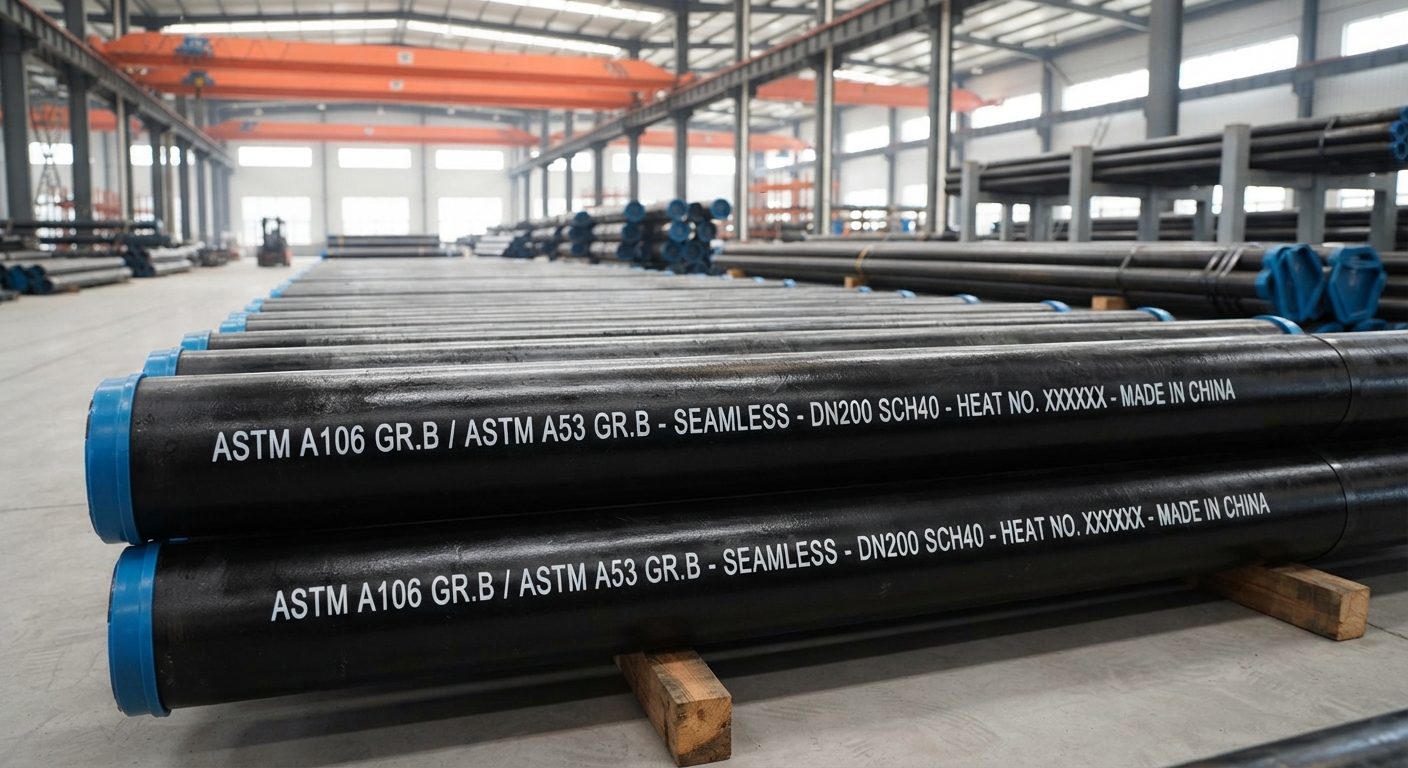
When sourcing carbon steel pipes for industrial piping, oil and gas, or structural projects, ASTM A106 and ASTM A53 are two of the most widely specified standards globally. Because both grades share similar mechanical strengths—especially Grade B—buyers often wonder whether they can be used interchangeably.
While they look alike on paper, ASTM A106 and A53 are designed for different operating environments. Choosing the wrong specification can lead to safety risks in high-temperature systems or unnecessary procurement costs. This guide breaks down their core differences in manufacturing, chemical composition, and applications.
| Feature | ASTM A106 | ASTM A53 |
| Primary Application | High-temperature & high-pressure service | Low-to-medium pressure, structural & general use |
| Manufacturing Process | Seamless only (Hot-finished or Cold-drawn) | Seamless (Type S), ERW (Type E), or Furnace-welded (Type F) |
| Common Grades | Grade A, Grade B, Grade C | Grade A, Grade B |
| Silicon (Si) Content | Min 0.10% (Essential for heat resistance) | Not specified (Often low or zero) |
| Hydrostatic & NDT Testing | Mandatory strict non-destructive testing | Standard hydrostatic or electric testing |
The most critical distinction lies in temperature and pressure tolerance:
ASTM A106 (High-Temperature Service): Specifically engineered for high-temperature and high-pressure environments, such as refinery piping, power plant boilers, steam lines, and petrochemical processing. It maintains structural integrity at temperatures exceeding 750°F (400°C).
ASTM A53 (General & Structural Service): Intended for mechanical and pressure applications at ambient or moderate temperatures, including water lines, air conditioning systems, fire protection sprinkler systems, and structural piling. It is not recommended for sustained high-temperature steam or thermal oil lines.
ASTM A106 is strictly a seamless pipe specification. It is produced exclusively through hot-rolling or cold-drawing without any weld seam, eliminating weak points under extreme thermal expansion and internal pressure.
ASTM A53 covers both seamless and welded pipes, categorized into three types:
Type F: Furnace-butt welded (Grade A only, rarely used for pressure).
Type E: Electric-Resistance Welded (ERW) — Grades A and B.
Type S: Seamless — Grades A and B.
(Note: While A53 Type S is seamless, it still lacks the mandatory silicon content required by A106 for high-heat applications.)
Both A106 Grade B and A53 Grade B offer identical minimum tensile and yield strengths, which is why dual-certified pipes (A106/A53 Gr.B) are common in the market. However, their chemical formulas differ:
| Parameter | ASTM A106 Grade B | ASTM A53 Grade B (Type S / E) |
| Carbon (C), Max | 0.30% | 0.30% |
| Manganese (Mn) | 0.29% – 1.06% | 1.20% Max |
| Phosphorus (P), Max | 0.035% | 0.05% |
| Sulfur (S), Max | 0.035% | 0.045% |
| Silicon (Si), Min | 0.10% Min | Not Required |
| Tensile Strength, Min | 415 MPa (60,000 psi) | 415 MPa (60,000 psi) |
| Yield Strength, Min | 240 MPa (35,000 psi) | 240 MPa (35,000 psi) |
ASTM A106 requires a minimum of 0.10% silicon. Silicon acts as a deoxidizer during steelmaking and prevents graphitization—a phenomenon where carbon steel becomes brittle after prolonged exposure to high temperatures. Because ASTM A53 has no minimum silicon requirement, using standard A53 in high-heat boilers can cause premature pipe failure.
A106 replacing A53: Yes, in most cases. Because A106 meets stricter chemical and seamless manufacturing standards, an A106 Grade B pipe can safely fulfill A53 Grade B requirements (though it comes at a slightly higher cost).
A53 replacing A106: No, not for high-temperature service. An A53 ERW or non-silicon seamless pipe cannot substitute for A106 in high-pressure steam or refinery lines.
Dual-Certified Pipes: Many modern steel mills produce A106/A53 Dual-Certified Seamless Pipes, which meet the strictest requirements of both standards simultaneously—simplifying inventory for EPC contractors and distributors.
At Shandong Jinbaifeng Steel Co., Ltd., we supply a full range of ASTM A106 Grade B seamless pipes, ASTM A53 Grade B ERW/seamless pipes, and API 5L line pipes in outer diameters from 1/2" to 48" (SCH 10 to SCH 160 / XXS).
100% Mill Test Certificates (EN 10204 3.1) provided with every shipment
Strict Quality Control: Ultrasonic testing, hydrostatic testing, and third-party inspection (SGS, BV, TUV) supported
Fast Export Delivery: Direct shipping from Qingdao Port and Tianjin Port with anti-rust coating, beveled ends, and protective end caps
Need a quote or technical consultation for your project?